
Property Owners
Who is responsible for sidewalk repair in NJ towns?
By Mehal Construction Corp. · Updated October 2026 · 5 min read
Key points
- New Jersey courts have generally held that residential owners have no duty to maintain the public sidewalk unless they caused or contributed to the problem.
- Commercial property owners can be held liable for sidewalk defects and for snow and ice next to their property.
- Many towns have ordinances requiring owners to repair sidewalks. Towns can enforce those with notices and fines, but the courts have said the ordinances don't create liability to an injured person.
- Most sidewalk work in the public right-of-way needs a town permit and has to follow the town's specifications.
A lifted slab in front of your house or business raises two questions: who has to fix it, and who is responsible if someone trips on it? In New Jersey, the answer depends a lot on whether the property next to the sidewalk is residential or commercial, and on your town's ordinance. Here's the general picture.
Homes: generally not liable, with exceptions
In Stewart v. 104 Wallace Street (1981), the New Jersey Supreme Court drew a line between residential and commercial property. Under the cases that followed, residential owners generally have no duty to maintain the public sidewalk in front of their homes.
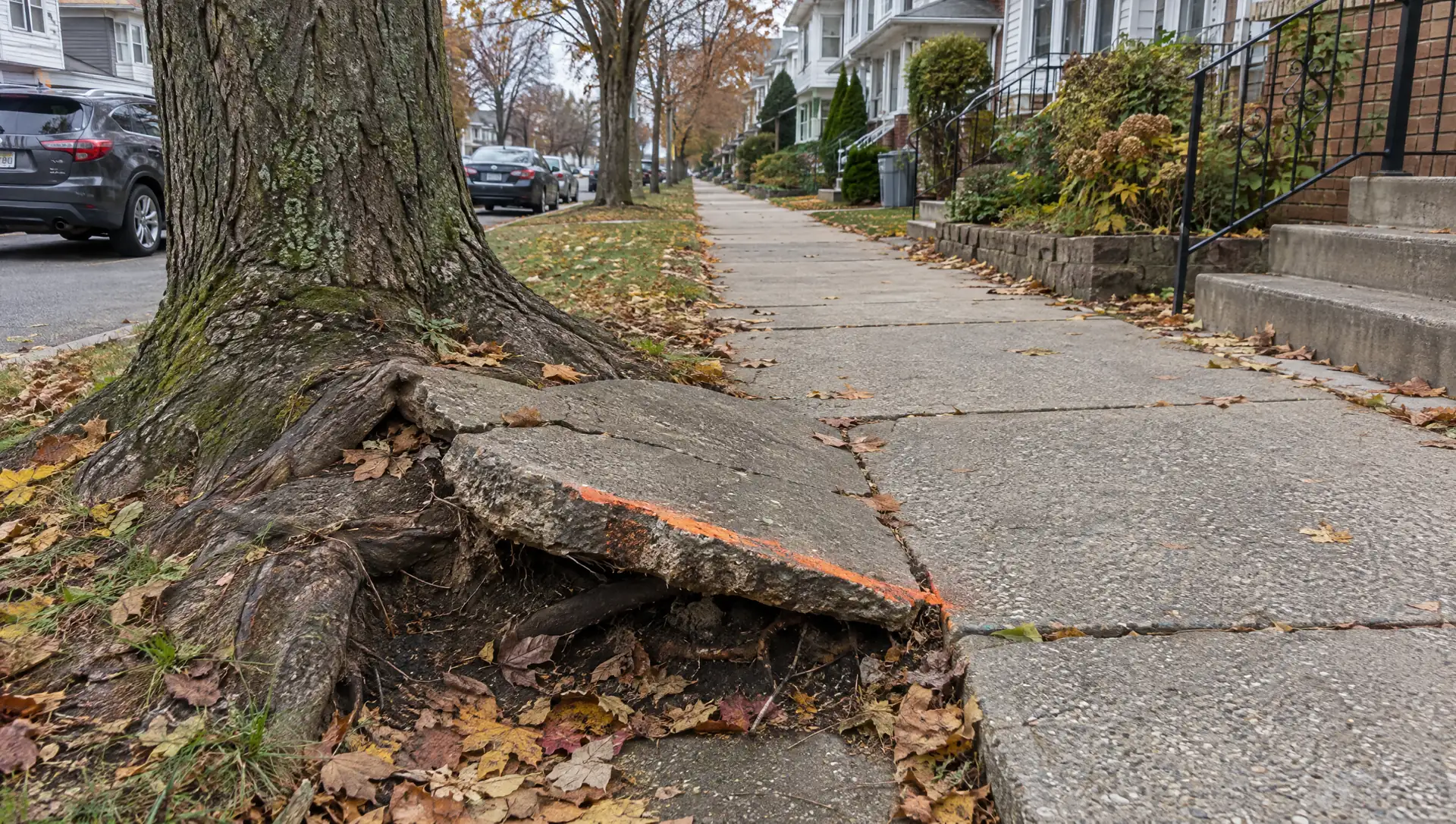
The exception is when the owner caused or contributed to the defect. Courts have looked at things like a tree on the owner's property whose roots lifted the slab, or a sump pump discharging onto the walk. The details of each case matter.
Businesses: a duty to maintain
Commercial property owners are treated differently. Under Stewart and later cases, including Mirza v. Filmore Corp. (1983) and Luchejko v. City of Hoboken (2011), a commercial owner can be held liable for a dangerous sidewalk condition next to the property, including snow and ice. The courts' reasoning is that businesses benefit from the foot traffic and can plan for maintenance and insurance.
Some properties fall in between, such as multi-family buildings, condominiums, churches and vacant lots. Those are decided case by case.
Town ordinances and repair notices
Many New Jersey towns have ordinances that require property owners to keep the sidewalk in repair and to clear snow. In Brown v. Saint Venantius School (1988), the Supreme Court said these ordinances don't make a residential owner liable to someone who gets hurt, but the town can still enforce them with notices and fines.
If you get a repair notice, read it closely. It usually tells you which sections are marked, the deadline, and whether you need a permit. Some towns offer to do the work and bill the owner.
What the repair usually involves
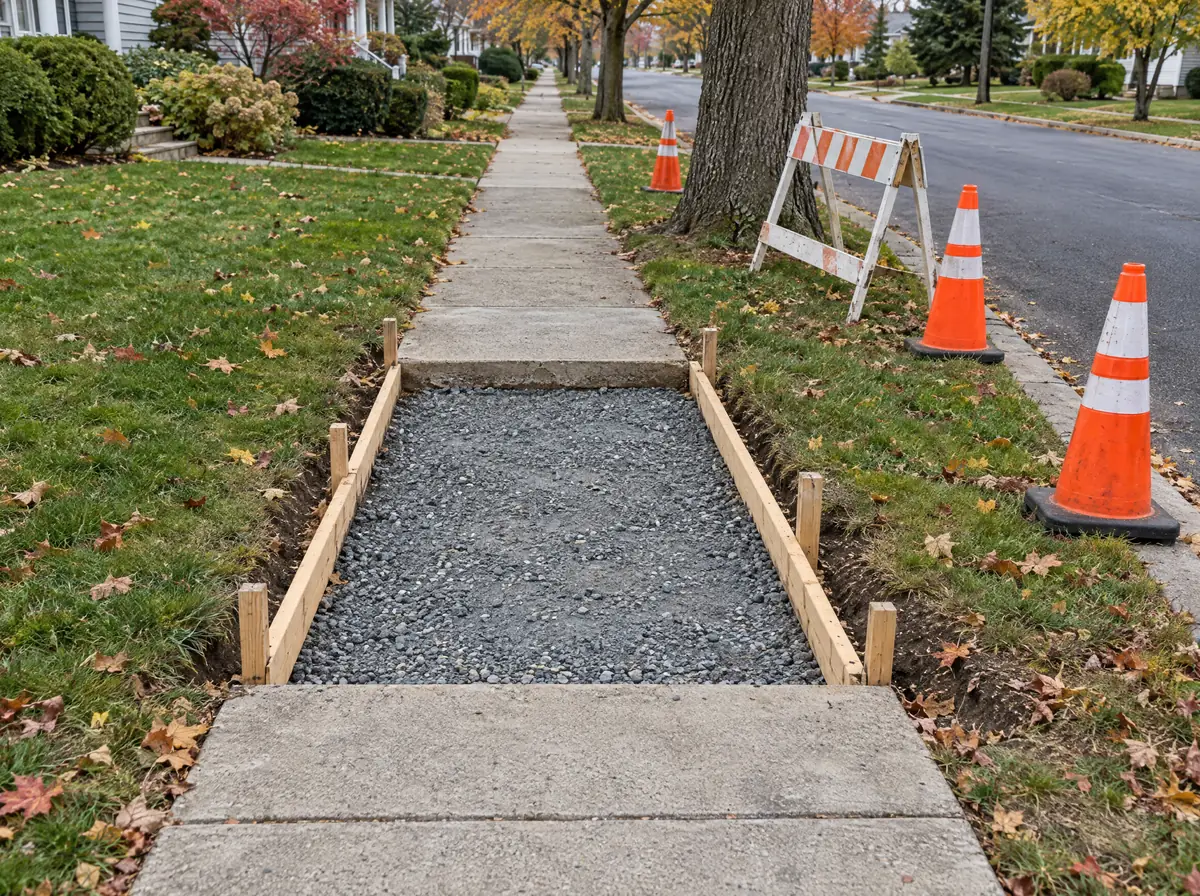
Sidewalk work in the public right-of-way is usually done to the town's specifications. Expect some or all of these:
- A permit from the town's engineering or construction office before work starts
- Removing the damaged flags (sections) completely, not patching over them
- A compacted stone base, forms set to the town's required width and thickness, and control joints
- A thicker section through driveway aprons
- If roots are involved, approval from the town or its shade tree commission before roots are cut
- An inspection before or after the pour, depending on the town
Ask your contractor to confirm the town's specs in writing before the work is priced.
Common questions
My town sent me a sidewalk repair notice. Do I have to do it?+
If someone trips on the sidewalk in front of my house, am I liable?+
Do I need a permit to replace my sidewalk?+
Sources
Got a sidewalk notice from your town?
Send us the notice and a few photos. We'll look at the scope and follow up during business hours.
Related guides
Homeowners
What to know before hiring a masonry or concrete contractor in NJ
Registration, written contracts, insurance and the questions that protect your project.
Read the guide
Public Works
ADA curb ramps: a plain-language guide for NJ municipalities and owners
Slopes, landings, detectable warnings and when road work triggers new ramps.
Read the guide